

7 Women's Clothing Size Chart Measurements That Fit
Last Updated: October 26, 2026
Quick Summary
Women's clothing size chart measurements map your bust, waist, and hip numbers in inches to a brand's size labels, and those ranges are typical rather than universal. Measure over thin clothing with the tape level and snug, then buy to your largest measurement because garments can be taken in but not let out.
- Measure your natural waist at the narrowest point above the belly button and below the ribs.
- Hips are measured at the fullest part of the seat, usually about 8 inches below the waist.
- A US 8 usually aligns with a UK 12 and an EU 38, but treat every conversion as approximate.
- Rigid fabrics with 0-1% elastane have almost no give, so buy to your largest measurement.
- Petite sizing shortens the rise and inseam for frames under about 5'4".
Table of Contents
- Why Women's Clothing Size Chart Measurements Vary So Much
- How to Measure Bust, Waist, and Hips at Home
- Reading a Women's Size Chart by Measurements
- Women's Clothing Size Conversion Chart: US, UK, and EU
- How to Measure Inseam for Pants (and Rise, Thigh, and Sleeve)
- How Fabric Elasticity and Body Shape Change Your Size
- Find Your Fit in Harper & Co. Denim
- Frequently Asked Questions
Why Women's Clothing Size Chart Measurements Vary So Much
A women's clothing size chart measurements guide only works if you accept one uncomfortable truth: the number on the tag is a suggestion, not a fact. A size 8 at one label can match a size 12 at another, and neither is lying.
Standard sizing is the practice of assigning letter or number labels to a fixed set of body measurements, and it has never been truly standardized across brands. The FTC's guidance on textile and apparel labeling requires labels to disclose fiber content and country of origin, not a universal fit guarantee.
Vanity Sizing and Alpha vs. Numerical Sizing
Vanity sizing is the practice of labeling larger garments with smaller size numbers to flatter shoppers. Alpha sizing uses S, M, L; numerical sizing uses even numbers like 6, 8, 10. Neither system tells you the bust, waist, or hip measurement in inches. Only the tape measure does.
How to Measure Bust, Waist, and Hips at Home
The most accurate approach is to measure over thin clothing or bare skin, keep the tape level and snug but not tight, and write down each number in inches.
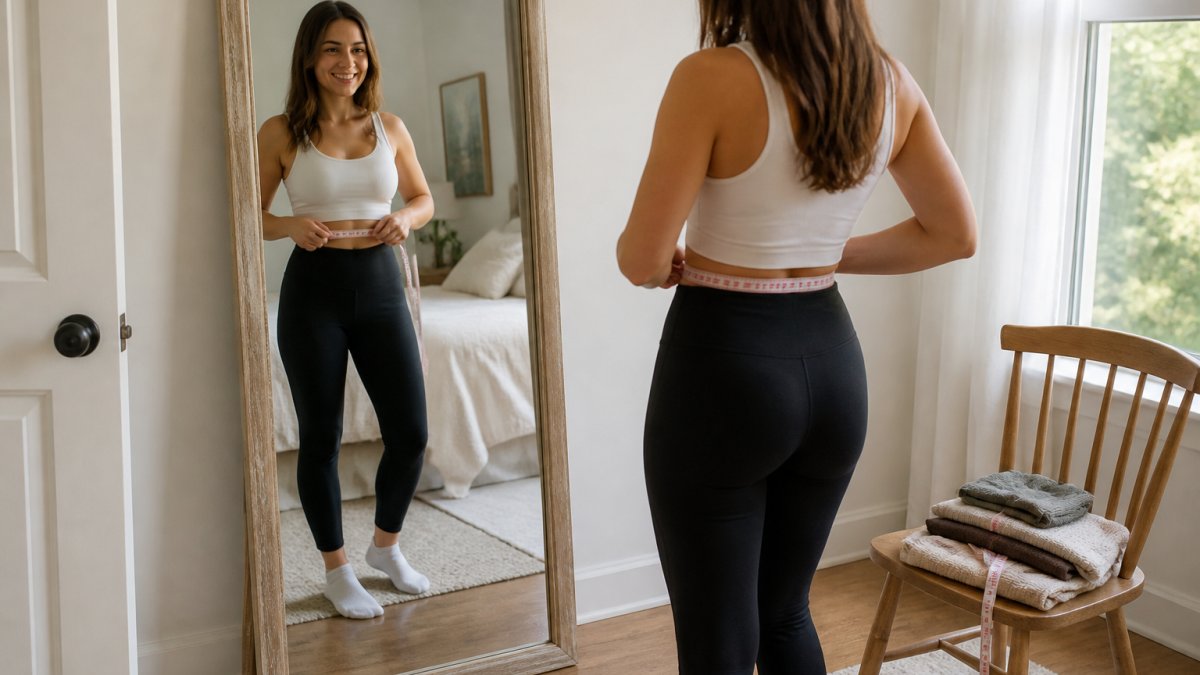
Bust, Waist, and Hip Step by Step
- Bust circumference: Wrap the tape around the fullest part of your bust, under your arms, keeping it parallel to the floor. Breathe normally.
- Waistline: Find your natural waist, the narrowest point above your belly button and below your ribs. Measure there, not at your pants waistband.
- Hip measurement: Stand with feet together and measure around the fullest part of your hips and seat, usually about 8 inches below your waist.
- Shoulder width: Measure from the edge of one shoulder bone across the back to the other.
- Record and repeat: Measure twice; if the numbers differ, take the average.
For a fuller walkthrough with tips on posture and tape placement, see our step-by-step body measurement guide.
Reading a Women's Size Chart by Measurements
A women's size chart by measurements is a table that maps body measurements in inches to size labels. Read the chart for the measurement closest to your largest dimension, not your smallest, because most garments can be taken in but not let out.
| Measurement | Where to Measure | Common Size 8 Range | Common Size 16W Range |
|---|---|---|---|
| Bust | Fullest part of chest | 34-35 in | 42-44 in |
| Waist | Natural narrowest point | 27-28 in | 35-37 in |
| Hips | Fullest part of seat | 37-38 in | 44-46 in |
| Inseam | Crotch to ankle bone | 30-31 in | 28-29 in |
Those ranges are typical, not universal. If you want to understand why the numbers drift between brands, our explainer on vanity sizing in women's clothing breaks down the history.
Petite, Tall, and Plus Size Ranges
Petite sizing shortens the rise and inseam for frames under about 5'4". Tall sizing adds length in the sleeve, torso, and inseam. Plus size ranges typically start at 14W or 16W and are drafted from a different block, not simply scaled up. That distinction matters: a well-made plus range adjusts the armhole, bust curve, and rise rather than multiplying a smaller pattern. Our guide to why size-inclusive patterns differ explains the drafting difference in plain terms.
Women's Clothing Size Conversion Chart: US, UK, and EU
A women's clothing size conversion chart translates labels across regions, but treat every conversion as approximate. A US 8 usually aligns with a UK 12 and an EU 38, yet international sizing bodies do not enforce a single equivalence, and brands apply their own grade rules on top of the nominal scale.
| US | UK | EU | Alpha |
|---|---|---|---|
| 4 | 8 | 36 | S |
| 6 | 10 | 38 | S/M |
| 8 | 12 | 38-40 | M |
| 10 | 14 | 40 | M/L |
| 12 | 16 | 42 | L |
| 14 | 18 | 44 | XL |
How to use the chart when your measurements disagree
The table above is a starting point, not a decision. The practical method is to convert your body measurements, not your usual size, and then resolve conflicts in a fixed order:
- Convert each measurement separately. Find the row where your bust lands, then the row where your waist lands, then the row where your hip lands. You will often get three different sizes, that is normal, not an error.
- Buy to the largest of the three for woven, rigid garments, because taking in is straightforward and letting out is not. For high-stretch knits, buy to the middle or the smaller measurement and let the fabric do the work.
- Check the garment's flat measurements against your body numbers plus the ease you want. A product page that lists a 28-inch flat waist on a size 8 tells you more than the conversion table ever will.
- Treat EU sizes as the least reliable column. EU labeling varies more between brands than US-to-UK, and the same EU 38 can fit like a US 6 or a US 10 depending on the house's grade rules.
Size equivalence breaks down fastest at the bust and hip, which is why the largest-measurement rule matters. If your bust and hip land in different rows, buy for the larger and tailor the rest. For a deeper method of comparing charts across labels, our complete guide to consistent sizing covers it.
How to Measure Inseam for Pants (and Rise, Thigh, and Sleeve)
To measure inseam, run the tape from the crotch seam of a pair of pants you already own down to the hem. That number, not your height, predicts whether a pair will hit at the ankle or pool at the floor.
- Rise: Measure from the crotch seam up to the top of the waistband. Hi-rise sits at or above the navel; mid-rise sits just below it.
- Thigh circumference: Wrap the tape around the fullest part of your upper thigh.
- Sleeve length: Measure from the shoulder seam to the wrist bone with your arm slightly bent.
Garment dimensions listed on a product page usually reflect the item itself, not your body, so compare them to a pair you already love.
Mid-Rise Relaxed Fit Mineral Wash Jeans →
How Fabric Elasticity and Body Shape Change Your Size
Most size charts are drafted around a single reference figure, and almost no brand tells you which one. That is why two women with identical bust, waist, and hip numbers can need different sizes: the chart assumes a standard hourglass, and your build may not be one. Fabric content adds a second variable on top of that. Treat the chart as a starting point, then adjust for the two factors below.
Read the fabric composition before the size chart
The stretch percentage on the label tells you more about fit than the size number does. A common pattern:
- Rigid (0-1% elastane or spandex): denim, structured twill, and most woven dresses. These have almost no give, so buy to your largest measurement, usually the hip or bust, and plan to tailor the rest.
- Moderate stretch (2-4%): most stretch denim and ponte knits. These relax with wear, so a pair that feels snug at hour one often fits correctly by hour eight. Size for the fit you want after a full day, not right out of the bag.
- High stretch (5%+): leggings, ribbed knits, and athletic wear. These can span two nominal sizes, which is why the chart matters less here and the garment's flat measurements matter more.
Recovery is the other half of the story. Elastane that snaps back holds its shape; cheap stretch that stays stretched sags at the knee and waist by midday. There is no label standard for recovery, so the practical test is to check the garment's flat waist measurement against your body waist and leave less ease in high-stretch fabrics, more in rigid ones.
Adjust the chart for your body shape
A chart gives you three numbers; your build tells you which one to prioritize.
- Pear (hips wider than bust): buy to the hip measurement and expect to take in the waist. A garment cut for an hourglass will gap at the waistband, so look for styles with a defined waist or plan a simple alteration.
- Apple (bust and midsection fuller, narrower hips): buy to the bust and waist, and size up if the waist is the largest number. Wrap dresses, empire waists, and high-rise bottoms drafted with more room through the middle fit better than straight-cut pieces.
- Athletic (shoulders and bust broad, waist less defined): shoulder width and bust drive the fit. If your shoulders exceed the chart's range for your size, size up and tailor the waist rather than fighting a too-narrow armhole.
Torso length and shoulder width are the two dimensions charts almost never list, and they explain most "fits everywhere but here" complaints. A long torso pulls a waist seam upward; narrow shoulders make a garment that fits your bust look oversized at the neckline.
This is where measurement accuracy pays off. A half-inch error at the waist compounds across a day of wear and across a size boundary.
Find Your Fit in Harper & Co. Denim
At Harper & Co., we publish the actual garment measurements for every pair of jeans, so you can compare them to your own numbers instead of trusting a label.
The Lily Hi-Waisted Tummy Control Jeans at $64.00 are our pick if you want a reinforced hi-rise with 4-way stretch and a 28-inch inseam across the size run. The Mid-Rise Relaxed Fit Mineral Wash Jeans at $25.00 suit a slimmer, ankle-length fit with a bleach-splash finish. If you prefer a relaxed leg, the Kyla Destroyed Hi Waist Relaxed Fit at $64.00 lists a 26 to 27-inch inseam depending on size.


Best for: shoppers who want to match a real waist and hip number to a real garment measurement. Skip if: you want a one-number sizing shortcut, because denim rewards the tape measure.
Ready to put your measurements to work? Shop the Lily Hi-Waisted Tummy Control Jeans and compare the size chart to your own numbers before you order.
Frequently Asked Questions
Is size 14 large or XL?
It depends on the brand, and that is the honest answer. In many US size chart measurements, a 14 lands at the top of the large range or the bottom of XL. Some brands run a straight 12-14 as large and 16-18 as XL, while others shift the whole scale down. Use your bust, waist, and hip numbers against that brand's own chart instead of trusting the letter. If you sit between two letters, size up for woven fabrics and stay true to size for stretch denim.
What women's size corresponds to a 33 inch waist?
A 33 inch waist usually falls around a US 14 or 16 in misses sizing, though it can read as a 12 in brands that cut generously. In denim, check the garment measurements rather than your body measurement, since jeans are cut with ease. For example, the 14W in the Lily Hi-Waisted Tummy Control Jeans lists a 33 inch waist, while the 15/32 in the Lorena Mid Rise Vintage Wash Bootcut Jeans lists 36 inches. Always compare your tape reading to the chart for that specific pair.
Should I size up if my measurements fall between sizes?
Size up for structured fabrics, tailored dresses, and anything with a fixed waistband, then have it taken in if needed. Size down only when the fabric has real stretch, like 4-way stretch denim. A quick test: check the fiber content. A blend with 1 to 2 percent spandex, such as the Judy Blue styles at Harper & Co., gives enough recovery to hold its shape, so your true size usually works. For 100 percent cotton or linen, go with the larger size.
How do I measure my bust, waist, and hips accurately?
Stand straight in light clothing with your feet together. For your bust, wrap a soft tape measure around the fullest part of your chest, keeping it level under your arms and across your back. For your waist, find the narrowest point above your belly button, usually about an inch above it, and keep the tape snug but not tight. For your hips, measure around the fullest part of your seat, roughly 7 to 9 inches below your waist. Write all three numbers down in inches and compare them to the brand's size chart.
How do I use a women's clothing size chart?
Start with your body measurements, not your usual size. Match your bust, waist, and hip numbers to the chart row that fits most of them, then prioritize the measurement that matters for the garment. For pants, the waist and hip matter most. For dresses and tops, the bust usually decides it. If your numbers split across two sizes, pick the larger one for woven fabrics and the smaller one for stretch knits. Keep a note of your measurements on your phone so you can check any chart in seconds.
