

Why Size Inclusive Patterns Differ From Standard
Table of Contents
- What Size Inclusivity Means in Pattern Design
- Standard Sizing Versus Size-Inclusive Patterns
- How to Measure Body for Clothing and Pattern Selection
- Sewing Pattern Grading Explained: Why Scaling Up Isn't Enough
- Body Proportions and Fit Across Size Ranges
- Common Sewing Pattern Fit Issues and How Inclusive Patterns Address Them
- How to Evaluate Whether a Pattern Is Genuinely Size Inclusive
- Frequently Asked Questions
Last Updated: October 8, 2026
What Size Inclusivity Means in Pattern Design
Size inclusivity in pattern design means creating garments that fit well across a genuine range of body sizes and proportions, not simply scaling a single pattern up or down.
Scaling alone creates fit problems: a dress that drapes beautifully on a size 8 frame won't hang the same way on a size 18 frame if you enlarge every measurement by the same percentage.
At Harper & Co., inclusive sizing means our pieces work for real bodies across our full range, because fit consistency across sizes isn't a luxury, it's essential.
Standard Sizing Versus Size-Inclusive Patterns
Standard sizing typically follows grading rules developed decades ago, often based on a single fit model or a narrow range of body types. These patterns grade proportionally: increase the bust by 2 inches and every other dimension grows by a proportional amount.
Size-inclusive patterns break from that single grading curve, using multiple grading rules that shift as sizes increase.
The key difference: standard sizing assumes one body shape scaled up or down. Size-inclusive patterns assume different body shapes at different sizes and grade accordingly.
How to Measure Body for Clothing and Pattern Selection
Accurate body measurements are the foundation for choosing the right pattern size. Take them consistently and compare against a pattern's size chart, not your usual clothing size (which varies wildly by brand).
Key measurements for pattern selection:
- Bust: Measure around the fullest part of the chest, keeping the tape parallel to the ground
- Waist: Measure at your natural waist, where your body bends
- Hip: Measure around the fullest part of the hips, typically 7-9 inches below the waist
- Shoulder width: Measure from shoulder bone to shoulder bone across the back
- Torso length: Measure from the base of your neck down the center front to your waist
When selecting a pattern, compare YOUR measurements to the pattern's size chart, not the labeled size.
Pattern grading affects which measurements change between sizes. In a well-graded pattern, shoulder width might increase 0.5 inches per size while bust increases 2 inches; understanding this relationship helps you predict whether a pattern will fit your proportions.
Sewing Pattern Grading Explained: Why Scaling Up Isn't Enough
Pattern grading is the process of creating a full run of sizes from a single master pattern, called a block. It is not photocopying at a larger percentage.
How standard grading works. A traditional block is drafted to one base size, then graded using fixed increments.
How size-inclusive grading differs. An inclusive pattern uses multiple grading rules that switch at defined size breaks, and it re-drafts the block itself rather than only shifting points. The practical differences show up in specific places:
- Armhole depth and sleeve cap. In standard grading, armhole depth may grow only 0.125 to 0.25 inch per size. Inclusive grading often increases it more in the upper range and re-drafts the sleeve cap so its curve still matches the deeper, wider armhole. If the cap isn't re-drafted, you get the puckering and pulling described later in this article.
- Shoulder and neckline. Shoulder width and neckline width are graded on their own curves rather than tied to bust. A neckline that widens at the same rate as the bust will gape; inclusive grading widens it more slowly and adjusts the front-neck drop separately.
- Waist placement and dart shaping. The vertical position of the waist and the length and angle of darts are re-set for larger sizes, because waist position does not sit at the same height on every body. Standard grading keeps the waist where the base block put it.
- Hip and seat shaping. Inclusive blocks add room at the seat and adjust the crotch curve and rise for pants, rather than scaling the hip circumference alone.
Why the two blocks can't share one curve. A standard block is built around one set of proportional relationships, bust-to-waist, shoulder-to-bust, torso length. A size-inclusive block is built around several, because those relationships genuinely change as sizes increase:
| Grading decision | Standard block | Size-inclusive block |
|---|---|---|
| Increment set | One fixed set for all sizes | Different sets at defined size breaks |
| Armhole depth | Small constant increase | Larger increase in upper sizes |
| Sleeve cap | Scaled from base cap | Re-drafted to match each armhole |
| Neckline width | Tied to bust increase | Graded on its own curve |
| Waist position | Fixed from base block | Re-set per size range |
| Block origin | One base size | Multiple base sizes or a re-drafted block |
What this means in practice. When a pattern is extended past its original range using the standard curve, failures cluster in predictable spots: tight armholes, a waistband that rides high, a neckline that stands away from the chest, a silhouette that turns boxy. These aren't sewing mistakes but grading decisions never revisited.
ASTM body measurement standards for apparel sizing
Body Proportions and Fit Across Size Ranges
Body proportions do not scale uniformly. Consider two people measured the same way:
- Size 8: 34-inch bust, 26-inch waist, 36-inch hip, a bust-to-waist drop of 8 inches, hip roughly 2 inches larger than bust.
- Size 18: 44-inch bust, 36-inch waist, 46-inch hip, a bust-to-waist drop of 8 inches, but the hip is now 2 inches larger than the bust and the waist sits at a different height relative to the bust.
Between those sizes the bust and waist each grew 10 inches, but the relationship between them, and between each and the shoulder, torso length, and arm length, changed. Simple scaling assumes those relationships are constant. They are not.
Where the proportions actually shift.
- Shoulder width grows slowly and unevenly. The distance from shoulder to shoulder may increase only about 0.25 inch per size, so a larger bust is often paired with proportionally narrower shoulders. A pattern that widens the shoulder at the same rate as the bust will produce a garment that slides off the shoulder.
- Torso length does not track bust size. Two people with the same bust can differ by 2 inches or more in the distance from shoulder to natural waist, which changes where a fitted waist seam should land.
- Arm and sleeve length vary independently of circumference. A larger arm circumference does not mean a longer arm, so sleeve cap height and cap ease must be set from the armhole, not from the bust.
- Waist position tends to sit lower relative to the bust as sizes increase, which is why a fixed waist placement rides high on larger bodies.
- Hip and seat depth change the crotch curve and rise for pants far more than the hip circumference alone suggests.
What each proportion means for fit. Matching a pattern to a body means matching the right measurement to the right part of the garment:
- Bust sets the size you start from for tops and dresses, but only if the pattern's bust ease matches what you want.
- Shoulder is the measurement most people ignore and the one that causes the most trouble. If your shoulder is narrower than the pattern's, the garment pulls across the chest; if wider, the shoulder seam sits inside your shoulder line.
- Waist and hip should be checked against the pattern's finished measurements, not the size label, because ease is built in differently at each.
- Torso length decides whether a waist seam, empire line, or crotch depth lands where it should.
Why one size label can't cover it. A single number on a pattern envelope describes one body's proportions, but real bodies vary in every one of those relationships at once, which is why two people who both "wear a 16" can need completely different adjustments.
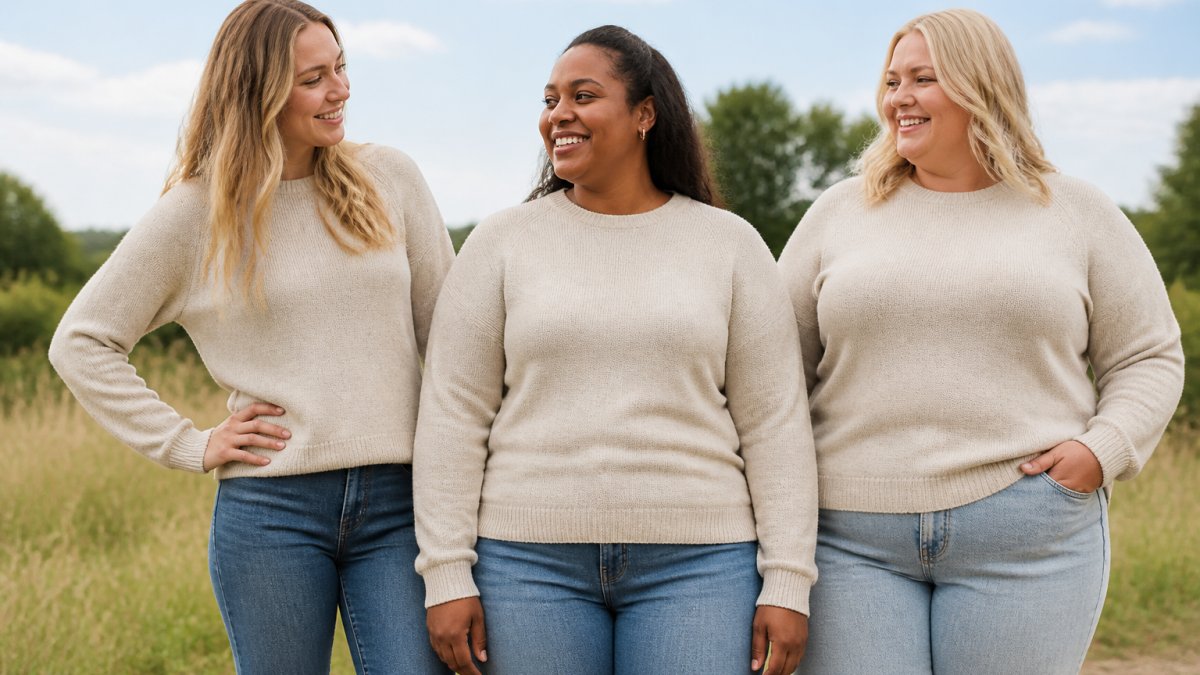
Common Sewing Pattern Fit Issues and How Inclusive Patterns Address Them
Pattern fit problems are often blamed on the maker's skill, but many stem from patterns not designed for the full size range being sewn.

Armhole pulling: The armhole sits too high or too tight, restricting arm movement.
Waist placement shifting: A fitted waist that sits correctly at size 10 might sit too high at size 18.
Sleeve cap puckering: Wrinkles appear at the top of the sleeve, usually because sleeve cap ease doesn't match the larger armhole.
Neckline gaping: The neckline pulls away from the body, creating gaps. This typically indicates the neckline width didn't increase proportionally with bust.
Silhouette distortion: The overall shape of the garment changes across sizes. A dress that's fitted at size 8 becomes boxy at size 18.
How to Evaluate Whether a Pattern Is Genuinely Size Inclusive
Not all patterns labeled "size inclusive" actually are. Genuine size-inclusive patterns show specific evidence of proportional adjustment across sizes:
Check the size chart: Compare measurements across sizes. Does bust increase by the same amount at every size interval, or does it vary? Does shoulder width increase proportionally to bust? Genuine inclusive patterns show varied increases, evidence that proportions were considered.
Look for grading notes: Quality pattern documentation explains grading decisions.
Review the fit model information: Does the pattern indicate which size was the fit model? Were multiple sizes tested?
Test with a muslin: A muslin (a test garment in inexpensive fabric) reveals fit before you commit to final fabric.
Check user feedback: Online communities and pattern reviews often mention fit consistency. Patterns that fit well across sizes tend to receive consistent praise.
| Evaluation Criteria | What to Look For | Red Flag |
|---|---|---|
| Size chart | Varied measurement increases per size | Same increase at every size interval |
| Documentation | Grading rules explained | No grading notes provided |
| Fit model info | Multiple sizes tested | Only one fit model mentioned |
| User reviews | Consistent fit praise across sizes | Size-specific fit complaints |
| Proportional details | Armhole, waist, neckline adjusted per size | All dimensions scaled proportionally |
Understanding these differences transforms your results, whether you're selecting patterns or choosing ready-made garments. Explore our curated selection of size-inclusive pieces, from our PLUS SIZE Crewneck in Coastal Canvas to versatile basics that celebrate your unique proportions.

Frequently Asked Questions
What is the difference between straight sizing and size-inclusive patterns?
Straight sizing scales a pattern proportionally across all sizes using the same grading rules. Size-inclusive patterns adjust grading rules at different size ranges to account for how body proportions actually change. For example, a size 2 and a size 20 don't have the same shoulder-to-hip ratio, so a truly inclusive pattern grades shoulder width, armhole depth, and torso length differently as sizes increase. This prevents fit problems like short sleeves or tight underarms that occur when patterns are simply enlarged.
Why do some patterns fit differently as sizes increase?
Body proportions shift across size ranges. Larger bodies often have different ratios of bust to waist, longer torsos, and different shoulder widths relative to their overall size. If a pattern uses the same grading increment for every size increase, these proportional differences aren't addressed. A garment graded with uniform increases might fit well at size 8 but pull across the back or have short sleeves at size 18. Inclusive patterns adjust grading rules to match how real bodies actually change in shape, not just scale.
How do I know if a brand like Harper & Co. actually designs for different body types and not just vanity sizing?
Look for brands that publish detailed size charts with multiple body measurements (bust, waist, hip, shoulder width, torso length) and show how garments fit across their full range. Genuine size inclusivity includes fit testing across the complete size range and visible adjustments in pattern construction. Brands committed to inclusive sizing often explain their grading philosophy openly. Harper & Co. curates size-inclusive pieces and offers free shipping on orders over $100, making it easier to try pieces across sizes and find what truly fits your body.
What should I look for in a truly size-inclusive pattern?
A genuinely inclusive pattern includes a detailed size chart with multiple measurements, not just bust size. Check whether shoulder width, armhole depth, sleeve length, and torso length all change meaningfully across sizes. Review fit notes or comments from makers who've tested the pattern across the full range. Look for patterns that acknowledge different body proportions and explain how the design adjusts for them. Avoid patterns labeled 'inclusive' that only provide bust measurements or that scale uniformly from size 2 to 24, as these often create fit problems at the extremes.