

What to Do When You're Between Clothing Sizes
Quick Summary
When you are between clothing sizes, measure your bust, waist, hips and inseam, then compare them to each brand's size chart. Choose the size that fits your hardest-to-fit area, since waistbands are easier to alter than hips or bust.
- Brands cut their patterns differently, so the number on the tag tells you less than your measurements.
- Measure bust, waist, hips, inseam and rise with a soft tape, snug but not tight.
- Size charts list flat garment measurements, so you usually need to double the width.
- Take in a waistband or shorten a hem, but a tailor cannot make a garment larger.
- Order your likely size and one size up or down, then try everything on within the return window.
Table of Contents
- Why You Fall Between Clothing Sizes
- How to Measure Your Body for Clothing
- Clothing Size Chart Measurements: Reading Them Correctly
- Should I Size Up or Down in Clothes?
- How Clothes Should Fit on Your Body
- Fabric, Stretch, and Tailoring Options
- Shopping Online and Returning Between Sizes
- Frequently Asked Questions
Why You Fall Between Clothing Sizes
Last Updated: November 19, 2026
Feeling stuck between clothing sizes is one of the most common frustrations in online shopping. Many women find that a size 12 fits the hips but gaps at the waist, while a size 14 fits the waist and swims everywhere else. The answer usually comes down to how brands cut their patterns.
Every clothing brand builds its sizes on its own block, and no two blocks match. A size 8 from one label can measure very differently from a size 8 from another. That is why the number on the tag tells you less than the measurements do.
Body shape adds to the problem. Your bust, waist, hips and rise can each land in a different size range. Most people carry their proportions unevenly, so a single size rarely fits every part of the body.
How to Measure Your Body for Clothing
Measuring yourself is the fastest way to stop guessing. Use a soft tape measure and keep it snug but not tight. Wear light, fitted clothing or underwear when you measure.
Take these measurements:
- Bust: Measure around the fullest part of the chest.
- Waist: Measure around the narrowest part, usually just above the belly button.
- Hips: Measure around the fullest part of the seat.
- Inseam: Measure from the crotch down to the ankle.
- Rise: Measure from the crotch seam up to the waistband.
Write these numbers down and keep them handy. Compare them to the size chart on each product page. The chart will tell you which size matches your strongest measurement.
Clothing Size Chart Measurements: Reading Them Correctly
Size charts list flat garment measurements, not body measurements. A flat measurement is taken across the garment laid on a table, so you usually need to double the width. Check whether a chart shows the full circumference or only half.
Look at the fit notes, too. Some charts say "true to size," while others say "runs small" or "runs large." Those notes can matter more than the size itself.
Pay close attention to stretch. A stretchy knit pair of jeans will fit differently than a rigid pair of wovens with the same flat measurements.
Should I Size Up or Down in Clothes?
Sizing up or down depends on what the garment does on your body. A useful rule is to choose the size that fits your hardest-to-fit area, then adjust the rest.
Many shoppers do well with a simple approach:
- Size up if the item is structured, like a blazer or a fitted waistband that you can alter.
- Size down if the item has plenty of stretch and you want a closer fit.
- Stay in your size if the measurements line up on most points.
Decision Guide by Garment Type
Different clothes call for different choices. Use this guide, then confirm with the garment's flat measurements and the fit notes on the product page.
| Garment | Usually choose | Why | What to check before you commit |
|---|---|---|---|
| Jeans | The size that fits the hips, then alter the waist | Hips are harder to change than waistbands | Sit down and check whether the waistband gapes at the back; confirm the fabric has some give or plan for a tailor |
| Trousers | The size that fits the hips and seat | Taking in a waist is routine; letting out hips is not | Check the rise and whether the pockets lie flat; pull the fabric at the thigh to see if it strains |
| Dresses | The size that fits the bust | Bust fit is hard to fix with alterations | Raise your arms and check for gaping at the armhole; confirm the waist can be taken in if needed |
| Shirts and blouses | The size that fits the shoulders and bust | Shoulder seams are the hardest to move | Button the front and check for pulling across the chest; check whether the back has a yoke or pleat that can be adjusted |
| Knit tops | The smaller size if you want a close fit | Knits stretch and relax over time | Check the fiber content; a high-stretch knit will relax, a firm knit will hold its shape |
| Blazers and jackets | The larger size, then tailor | Structured fabric holds its shape and is hard to let out | Check the shoulder seam sits at the edge of your shoulder; confirm the sleeve length can be shortened |
| Leggings and activewear | The size that fits the hips and thighs | Stretch fabric forgives small waist gaps | Bend and squat to check for sheerness; confirm the waistband stays put when you move |
Denim and knits behave very differently. Denim with little stretch needs more room because it will not give after washing. Knits with good recovery can fit snugly without feeling tight, but a knit with poor recovery will bag at the knees and elbows. When a garment sits between sizes, ask which failure you would rather fix: a waistband that is slightly loose (easy to tailor) or a hip that is slightly tight (hard to fix).
Watch out: do not size down in a structured garment just because the next size up feels roomy in the store. Structured fabrics do not relax the way knits do, and a blazer that is too small at the shoulder cannot be saved by a tailor.
How Clothes Should Fit on Your Body
A well-fitting garment should feel comfortable and move with you. Check these areas first:
- Shoulders: The seam should sit at the edge of your shoulder.
- Bust: Fabric should lie flat without pulling or gaping.
- Waist: You should slide one or two fingers under the waistband.
- Hips: Fabric should skim the curve without tightness.
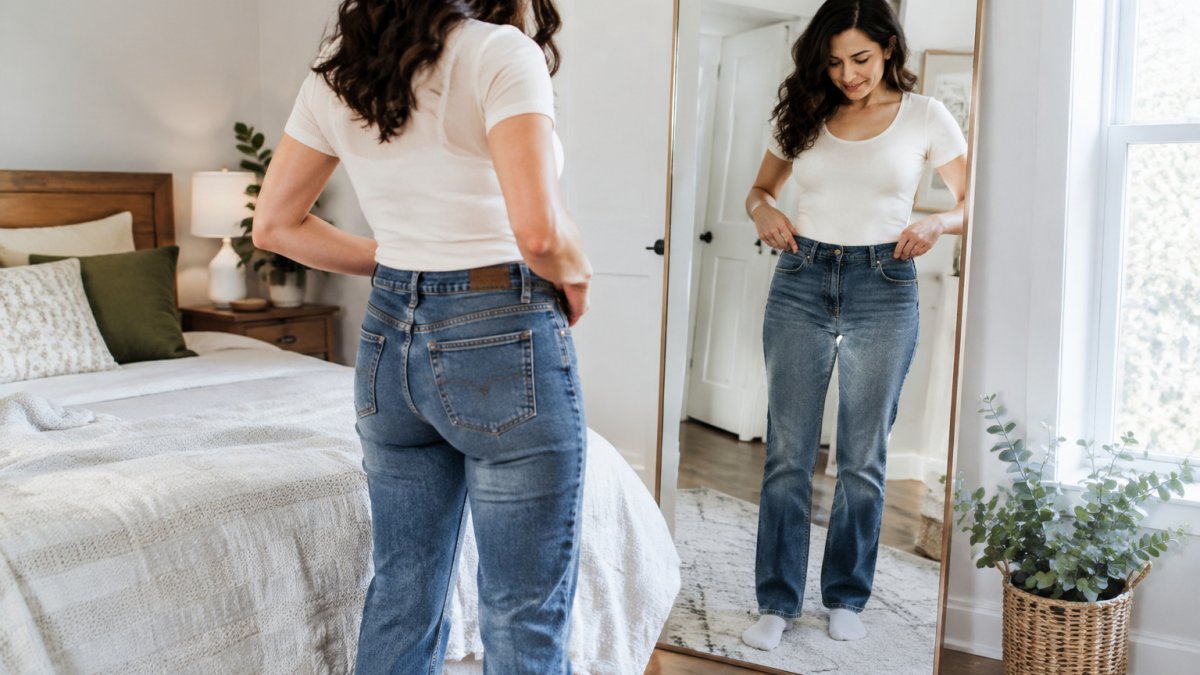
Stand in front of a mirror and move around. Reach, bend and sit. If fabric pulls across your hips or gapes at the bust, try the next size up or consider alterations.
!Woman in her 30s standing in front of a full-length mirror in a bright bedroom, wearing straight-leg jeans and a fitted top, checking the waistband and hem
Learn to spot the difference between a tight fit and a sign of the wrong size. Pulling at the seams usually means the size is too small. Excess fabric in a straight line often means the size is too big.
Fabric, Stretch, and Tailoring Options
Fabric matters as much as size. Stretch fabric forgives small differences, while woven fabric does not. Cotton can also shrink after washing, so check the care label before you decide. A garment that fits perfectly in the dressing room can shrink a full size after the first hot wash and dry cycle, which is why preshrunk cotton and wash-cold, hang-dry care matter when you are already between sizes.
Stretch is not a single thing. Look at two numbers on the label: the fiber content and, when listed, the stretch percentage. A cotton-spandex blend with 2 percent spandex gives a little; a ponte knit with 5 percent or more gives a lot. Recovery matters as much as stretch: a fabric that stretches but does not snap back will bag out at the seat and knees by the end of the day. Ribbed knits and firm ponte hold their shape better than loose jersey.
Construction changes the fit, too. A lined garment fits differently than an unlined one because the lining adds structure and reduces give. Seams with a generous seam allowance can be let out; seams that are serged close to the edge cannot. Check the inside of the garment before you buy if you plan to alter it.
Which Alterations Are Worth It
Tailoring can close the gap, but not every fix is equal. Use this guide to judge feasibility before you pay.
| Alteration | Difficulty | When it is worth it |
|---|---|---|
| Take in a waistband | Straightforward | Jeans or trousers that fit the hips but gap at the waist |
| Shorten a hem | Straightforward | Most trousers, skirts, and sleeves; easiest on plain hems |
| Take in side seams | Straightforward to moderate | Dresses and tops that are slightly loose through the body |
| Shorten sleeves | Moderate | Blazers and shirts, if the cuff can be moved |
| Let out a seam | Moderate | Only if the garment has a real seam allowance to work with |
| Adjust shoulders | Difficult | Rarely worth it; rebuilding a shoulder changes the whole garment |
| Fix a bust or hip mismatch | Difficult | Usually not worth it; the cost can approach the price of a new garment |
Alterations usually cost less than buying a new garment, but they cannot fix a bust or hip mismatch. A simple hem or waist take-in is the kind of alteration most tailors handle routinely; moving a shoulder or reshaping a bust is specialist work and often costs more than the item is worth.
Ask yourself these questions before you pay for alterations:
- Is the fit problem in a seam that can be moved?
- Is the fabric thick enough to take in without showing old stitch lines?
- Will the change still look right on the garment?
- Does the garment have a lining that will need to be adjusted too?
Watch out: a tailor can make a garment smaller, but almost never larger. If the item is tight across the bust or hips, sizing up and tailoring down is the safer path than buying the smaller size and hoping it can be let out.
Shopping Online and Returning Between Sizes
Shopping online means you cannot try clothes on first. Read customer reviews that mention height and body type. Look for notes about how the fabric feels.
If you order two sizes, plan your returns before the package arrives. Keep tags attached, try each piece on right away and check the return window. Most stores expect items back unworn and unwashed.
Consider these practical tips:
- Order your likely size and one size up or down.
- Try everything on within the return window.
- Return the sizes that do not fit to avoid paying for alterations you don't need.
Browse our Shop Collection to find pieces that fit your measurements, then start building a wardrobe that feels like yours.
Frequently Asked Questions
Should I size up or down when I'm between sizes?
Size up if the garment is hard to move in, pulls at the bust, hips, or thighs, or if the fabric does not stretch. Size down if the waist gapes, the shoulders hang past your natural line, or the fabric is stretchy enough to recover a snug fit. For jeans and structured pieces like blazers, most people do better sizing up and having the waist taken in by a tailor, since letting out a garment is often harder. For knits and four-way stretch denim, sizing down can work well if the fit is snug without restricting movement.
How do I measure my body for clothing?
Use a soft tape measure and keep it level. Measure your bust at the fullest point, your waist at the narrowest point (usually just above the belly button), and your hips at the fullest part of your seat. Keep the tape snug but not tight, and stand relaxed in your underwear. Compare these numbers to the brand's size chart rather than the size you usually wear, because sizing varies between brands and garment types.
Can a tailor fix clothes that are too big or too small?
A tailor can often take in a waistband, sides, or the back seam of a garment that is too big, and can let out seams if there is enough extra fabric in the seam allowance. Taking in is usually more reliable than letting out, so buying the slightly larger size and tailoring the waist is a common approach. Costs vary by region and garment complexity, so ask for a quote before committing to a larger alteration.
Do clothing sizes vary between brands?
Yes. Brands cut patterns differently and use different fit blocks, so a size 12 from one label can measure several inches different from another. Always check the specific brand's measurement chart. For Harper & Co. pieces, such as the Doris Mid Rise Boyfriend with Adjustable Back Tab, the listing shows the exact waist, hip, rise, and inseam measurements for each size, which makes comparison easier than guessing from your usual size.
