

How to Coordinate Family Outfits Stylishly
Table of Contents
- Start With a Cohesive Color Palette for Family Photos
- Mix Textures and Patterns Without Clashing
- Family Photoshoot Outfit Ideas That Work Together
- Comfortable Trendy Clothes for Busy Moms
- Layer for Visual Depth and Seasonal Flexibility
- Accessorize to Tie Everything Together
- Coordinate Family Outfits Without Overly Matching
- Common Mistakes to Avoid When Styling Family Looks
- Frequently Asked Questions
Last Updated: October 4, 2026
Start With a Cohesive Color Palette for Family Photos
A thoughtful color palette is the foundation when you coordinate family outfits. Choose colors that complement each other and create visual harmony, this means coordinating, not matching.
Start by selecting 2-3 main colors and 1-2 accent shades. Neutral tones work best as your base because they let textures and patterns shine without overwhelming the eye.
Neutral Tones as Your Foundation
Neutral colors like cream, beige, gray, navy, and soft white work across all skin tones and age groups. They let textures and patterns stand out without clashing, a cream sweater and cream linen shirt coordinate beautifully while looking distinct.
Pick one neutral as your dominant color. If four people wear cream and one wears navy, the group feels cohesive.
Adding Complementary Accent Colors
Add 1-2 accent colors that sit opposite each other on the color wheel (cream + sage green, beige + rust, gray + mustard yellow, navy + blush pink). Use them sparingly: let one person wear the accent color as their main piece while others incorporate it through accessories.
Color theory principles for design show that limiting your palette to 3-4 colors creates stronger visual impact than using many colors. This principle applies directly to family photo coordination.
Mix Textures and Patterns Without Clashing
Texture mixing creates depth and visual interest. Layer soft cotton with structured linen, smooth knit with fuzzy fleece, or matte fabric with subtle sheen.
Mix patterns by keeping them in the same color family and varying their scale. A small floral and large geometric in navy and cream work together; different colors do not. Safest approach: one person wears a bold pattern while others wear solids or tiny prints.
Family Photoshoot Outfit Ideas That Work Together
Your photo session's setting, season, and lighting should influence your color palette and outfit choices.
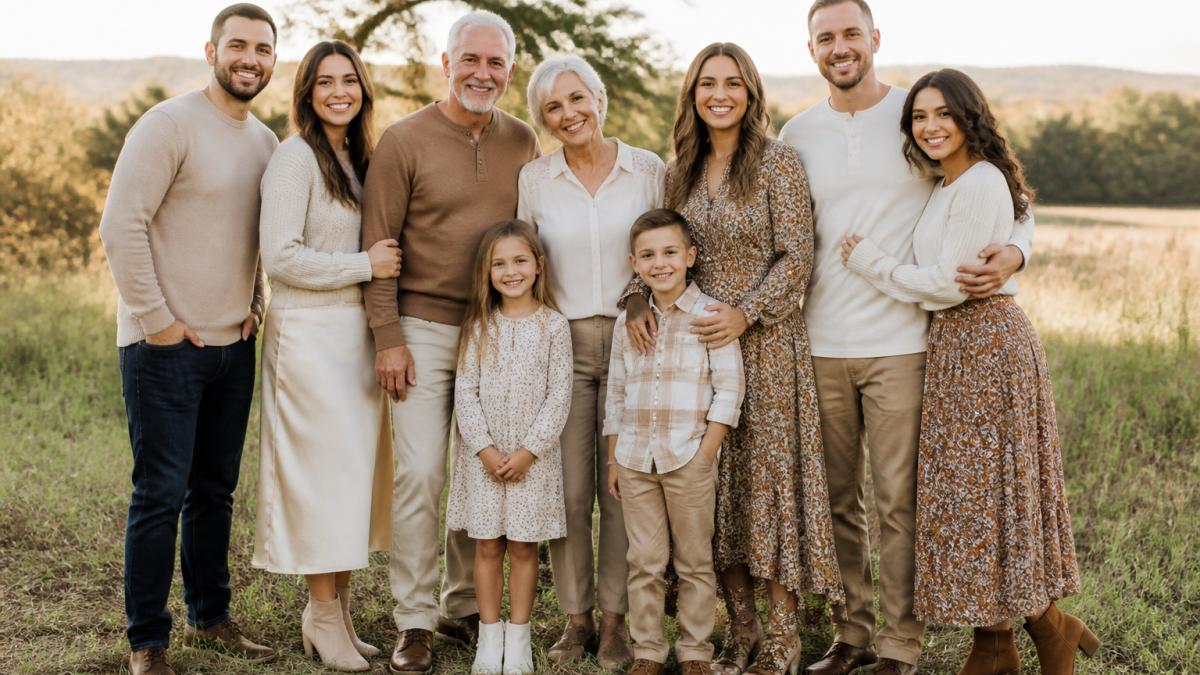
Choosing Colors Based on Lighting Conditions
Golden Hour (Sunset/Sunrise) Outdoor Sessions
Golden Hour: Use warm neutrals (cream, tan, warm gray) and warm accents (rust, terracotta, warm sage green). Avoid cool grays, cool blues, and pure white.
Midday Bright Sunlight
Midday Sun: Use saturated, deeper tones (navy, charcoal, deep forest green) and jewel tones (emerald, sapphire, amethyst). Avoid pale pastels and very light neutrals.
Indoor Studio or Overcast Day
Studio/Overcast: Use cool neutrals (soft gray, cool white, cool beige) and cool accents (sage green, soft blue, blush pink). Avoid very warm tones and overly saturated colors.
Seasonal Lighting Shifts
Seasonal light varies: summer is brighter and bluer, fall is warmer and golden, winter is softer and cooler, spring is variable. Ask your photographer about lighting conditions and choose your palette accordingly.
Age-Appropriate Styling for Comfort and Confidence
Family coordination only works if everyone feels comfortable and confident. Styling needs vary by age.
Toddlers (Ages 1-3)
Toddlers (1-3): Choose soft, stretchy fabrics and simple silhouettes that allow movement. Avoid stiff fabrics, tight waistbands, and complicated closures. A comfortable toddler in soft cream and sage green coordinates beautifully.
Young Children (Ages 4-8)
Young Children (4-8): Use familiar silhouettes in coordinating colors and let them pick one special piece. Avoid forcing unfamiliar styles or uncomfortable shoes. A child who picks their own accent-color piece feels ownership and photographs naturally.
Tweens and Teens (Ages 9-18)
Tweens/Teens (9-18): Let them pick their own pieces within the color palette and honor their style preferences. Avoid forcing matching pieces or unfamiliar styles. A teenager who feels respected will be more relaxed in photos.
Formal Family Portraits
Formal Portraits: Use palettes like cream/navy/gold, soft gray/white/blush, or charcoal/cream/cognac. Each person picks one main piece (blazer, structured dress, elevated button-up). Base layer + main piece + coordinating bottoms + one accessory.
Casual Outdoor Sessions
Casual Outdoor: Choose one neutral base color and let everyone pick different casual pieces in that color (linen shirt, soft sweater, t-shirt). Add one accent color through accessories or one person's main piece. Base + texture variation + one accent piece + comfortable shoes.
Comfortable Trendy Clothes for Busy Moms
Coordinating family outfits doesn't require a new wardrobe. Audit what you already own, identify pieces in your color palette, and build outfits before shopping for gaps.
Build From Your Existing Wardrobe First
Pull pieces from your closets that match your 3-4 color palette: neutral basics, accent-color pieces, textured items, and layering pieces. You likely have 60-70% of what you need without spending anything.
Strategic Shopping for Missing Pieces
List specific gaps and shop strategically. Prioritize versatility, quality over quantity, timeless cuts, and size-inclusive basics.
Budget-Friendly Layering for Maximum Outfit Combinations
Layering multiplies your outfit options without multiplying costs. Three base pieces, three mid-layers, and two outer layers create dozens of combinations, all within your color palette.
Example budget-friendly layering set:
- Base: cream tee, navy tee, white long-sleeve tee ($15-25 each)
- Mid-layer: cream cardigan, navy sweater, rust overshirt ($30-50 each)
- Outer: structured jacket in cream or navy ($40-80)
Total investment: $200-350 for pieces that work across your entire family (scaled to different sizes) and create multiple outfit combinations. Each piece is worn repeatedly, not just for photos.
Merry Christmas Raglan Sweatshirt — Cozy Holiday Crewneck →
Thrift and Secondhand Options
Thrift stores and online secondhand platforms (Poshmark, Depop, ThredUP) are goldmines for coordinating pieces. Neutral basics in good condition are abundant and cost 50-70% less than retail. This approach is especially useful for:
- Finding specific textures (linen, quality knits, structured fabrics) at lower price points
- Sourcing pieces for children who outgrow clothes quickly
- Testing whether a color or style works for your family before investing in new retail pieces
When shopping secondhand, filter by color and fabric type to stay within your palette. A cream linen shirt or rust sweater in good condition works just as well as a new piece and costs a fraction of the price.
The Cost-Per-Wear Calculation
When deciding whether to buy a piece, calculate its cost per wear. A $60 sweater worn 40 times costs $1.50 per wear. A $120 outfit worn once for photos costs $120 per wear. Pieces you'll wear repeatedly after the photo session provide far better value.
This mindset shifts family coordination from "buying an outfit for photos" to "building a wardrobe that coordinates." You're investing in pieces you'll actually wear, which means the money spent benefits you long-term, not just for one event.
Layer for Visual Depth and Seasonal Flexibility
Layering serves two purposes: it creates visual depth in photos and it lets you adjust outfits for different seasons. A family in three-dimensional, layered looks photographs better than a family in flat, single-layer pieces.
Start with a base layer, a tee or thin sweater in your neutral color. Add a mid-layer, a cardigan, blazer, or overshirt. Finish with an outer layer if the season calls for it, a jacket or structured coat.
Each layer should be a different texture. Smooth cotton base, textured knit cardigan, structured linen jacket. This creates visual interest without color clashing.
Layering also solves the temperature problem. Someone might be cold while another person is warm. Layers let everyone adjust without disrupting the coordinated look.
Seasonal layering ideas:
- Spring: tee + lightweight cardigan + linen shirt
- Summer: tank + short-sleeve shirt (unbuttoned)
- Fall: tee + sweater + structured jacket
- Winter: base layer + sweater + coat
Accessorize to Tie Everything Together
Accessories are where you can add personality without disrupting coordination. A scarf, belt, hat, or jewelry piece can tie an outfit together and add that final touch that makes a family look intentional.
The rule is simple: keep accessories in your color palette. If your family is wearing cream, navy, and rust, your accessories should also be cream, navy, rust, or metallics that work with those colors.
Accessories that coordinate family looks:
- Scarves in accent colors or patterns
- Belts that define silhouettes
- Hats or beanies in neutral tones
- Jewelry in gold, silver, or rose gold
- Shoes in coordinating colors
One family member might wear a rust scarf while another wears a rust belt. Both are coordinating without matching. This is where individual style shines through while maintaining group cohesion.
Coordinate Family Outfits Without Overly Matching
The biggest fear when coordinating family outfits is looking like you're wearing matching pajamas. You're not trying to match. You're trying to coordinate.
Matching means everyone wears the same outfit. Coordinating means everyone wears different pieces that work together.
The difference comes down to variation:
- Different silhouettes (fitted top, loose sweater, structured jacket)
- Different textures (smooth, knit, linen)
- Different patterns (one solid, one stripe, one small print)
- Different accessories (scarf, belt, hat)
Each family member should still look like themselves. A kid who loves bold colors should wear a bold piece in your palette. A parent who prefers minimalism should wear a clean, simple piece. Everyone coordinates without losing their personality.
The formula:
- Same color palette (everyone wears cream, navy, and rust)
- Different pieces (sweater, dress, shirt, blazer)
- Different textures (knit, linen, cotton, structured fabric)
- Different accessories (each person adds one personal touch)
This approach means you're not buying matching outfits. You're shopping your own closet and your family's closets, pulling pieces that work together. This saves money and feels more authentic.
Common Mistakes to Avoid When Styling Family Looks
Understanding what doesn't work helps you make better choices. Here are the patterns that break coordinated family outfits.
Too many colors. Five different colors across five family members feels chaotic. Stick to 3-4 colors maximum.
Mixing pattern scales without intention. A tiny stripe and a large floral in different colors create visual noise.
Ignoring texture. A family in all smooth fabrics looks flat in photos. Add texture variety through knits, linen, structured fabrics, and layering.
Forgetting the season. Heavy winter sweaters in summer photos feel wrong. Light summer fabrics in winter photos don't work.
Prioritizing matching over comfort. If someone is uncomfortable, it shows in their face. Choose pieces everyone can actually wear and move in.
Buying outfits specifically for photos. Pieces you'll wear again have more value than one-time photo outfits.
Coordinating family outfits doesn't require matching or spending a lot of money.
Frequently Asked Questions
How can I coordinate sibling outfits without looking too matchy?
Keep siblings in the same color palette but vary the garment types and textures. For example, one child wears a solid sweater while another wears a patterned top in complementary colors. Use different shades of the same neutral tone, one in cream, another in taupe, to create visual harmony without appearing identical. Accessories like belts, scarves, or jewelry can tie the look together while maintaining individual style.
What color palettes work best for family outfit coordination?
Neutral foundations like cream, beige, gray, and navy work universally. Layer in one or two accent colors across the family, soft sage, dusty rose, or warm terracotta create cohesive aesthetics without feeling forced. Seasonal color palettes work well too: warm earth tones for fall, cool pastels for spring. A practical approach is choosing three colors maximum to maintain visual balance and ensure every family member has complementary options.
How do I know if I'm mixing patterns and textures correctly?
Follow the 60-30-10 rule: 60% solid colors, 30% one pattern type, and 10% a second pattern or texture. If one family member wears a striped top, another might wear a subtle floral or textured knit. Pair bold patterns with solids, and mix different texture weights, a soft sweater with structured pants, or a lightweight linen with a cozy fleece layer. Test combinations before committing to ensure they feel balanced and intentional.
How can I coordinate family outfits on a budget?
Build your wardrobe around versatile basics in neutral colors that mix and match across seasons. Invest in quality basics like solid crewneck sweatshirts, pieces like the Merry Christmas Raglan Sweatshirt ($50) or Santa Shops Here Crewneck ($36.99) from Harper & Co. work for multiple occasions and coordinate easily. Rotate seasonal accent pieces, and prioritize comfort and fit over quantity. A smaller, well-coordinated wardrobe stretches further than many pieces that don't work together.